
NYN037 People Doing People-y Things
A squirrel, a seagull, Therians, and 56 AA batteries.


THE NUMBERS
3 — Number of month’s Washington state’s Spanish hotline spoke English with an accent before anyone fixed it.
4:35 — the time that a PC ran on AA batteries
5 — Number of theories competing to explain the outage of communications in Medina County, OH that turned out to be a squirrel chewed their fiber optic cable.
8 — Months between Malcolm Neville’s 1916 letter and his death in France
22 — Minute of the match when the seagull’s luck ran out
56 — AA batteries required to play Minesweeper on easy for four and a half minutes
109 — Years the bottle waited in the sand dunes at Wharton Beach
2,000,000 — TikTok posts under #therian, Argentina leading the world
INTRO
Some weeks the news arrives like a boot through the door — loud, urgent, impossible to ignore. This is not a column about that news. That news is everywhere. You have already read it. You will read more of it before the day is out.
This week we are going elsewhere.
This week a squirrel took down an Ohio county government and exposed a backup system nobody had tested. Teenagers in Buenos Aires put on fox masks and ran in the park on a Sunday, and a psychologist explained that this is fine as long as nobody gets hurt. The state of Washington spent several months providing Spanish-language services to its residents in English, with an accent, and called it a glitch. A man in Istanbul performed CPR on a seagull during an amateur playoff final. A YouTube creator powered a desktop computer with 56 AA batteries long enough to win one game of Minesweeper on easy. And on a beach in Western Australia, a woman picking up trash found a bottle in the sand containing a letter from a 27-year-old soldier who had been dead for 109 years, asking the finder to please forward it to his mother.
We are going to see these people. Learn their names. Most of them did something — small or large, absurd or quietly extraordinary — that is worth holding in your mind alongside everything else the week has handed you.
That’s what we’re here for. Let’s get into it.
The Squirrel Did It
When phone and internet service went dark across Medina County, Ohio on February 20th — government offices, the county prosecutor’s office, all of it — officials were fairly certain a contractor must have clipped an underground fiber line doing nearby work. Plausible. Happens all the time. The commissioners joked that investigators had ruled out pretty much everything short of aliens.
It was not the contractors.
A squirrel had built a nest inside the fiber infrastructure and chewed through multiple lines. County Administrator Matt Springer delivered the finding at a commissioner’s meeting with the patience of a man who has made his peace with the world. “It’s hard to make this stuff up,” he said.
Then came the part they buried in the follow-up: redundant backup systems that should have prevented a total outage were, in Springer’s careful phrasing, “not configured properly.” The squirrel took the network down. The backup let it stay down. Nobody had tested it. Steps are now being taken. The squirrel has not been named.
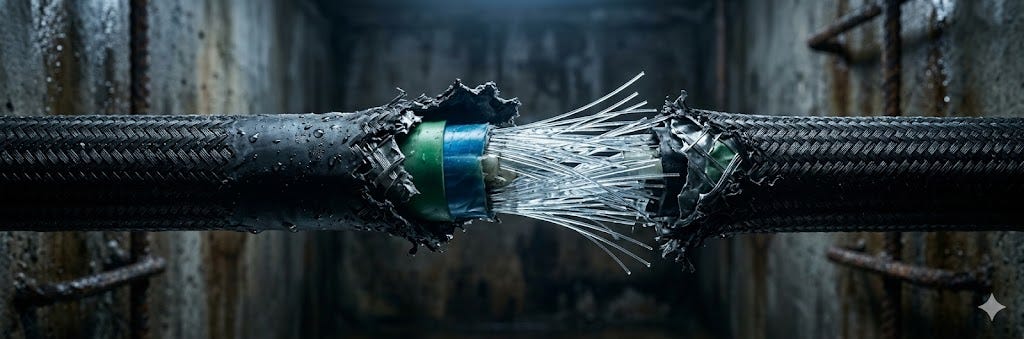
A commenter on one news story noted that a beaver once took out fiber internet for an entire town in British Columbia by cutting the cable out of the ground and weaving it into his dam. Another commenter claimed cable companies in squirrel-prone areas have switched to pepper-infused cable lines, so the animals get a mouthful of hot sauce when they bite in. We cannot confirm this. We choose to believe it.
MY TAKE: The commissioners floated every theory — contractors, equipment failure, everything but aliens — and the truth was a squirrel with ambitions and no permit. That’s funny. What’s less funny is that the backup system, the one that exists precisely for moments like this, wasn’t set up right. Nobody knew, because nobody had run the test. A squirrel found the gap before the IT department did. This happens in government, in business, in hospitals — the redundancy exists on paper, the drill never gets scheduled, and one Tuesday a rodent with a nest to build takes down the county prosecutor’s office. The squirrel was just doing squirrel things. The humans had one job.
Running with the Pack
On a recent Sunday afternoon, a plaza in Buenos Aires became something else. Sofía arrived wearing a lifelike beagle mask and moved across the grass on all fours. Fifteen-year-old Aguara — the name she goes by — cleared a series of obstacles imitating the precise movements of a Belgian shepherd. Others climbed trees dressed as cats and foxes, keeping their distance from curious onlookers. This was a gathering of “therians”: teenagers who identify mentally, spiritually, or psychologically with non-human animals. The trend has taken over Argentine TikTok, with the hashtag topping two million posts and Argentina leading the world. Aguara coordinates regular meetups around the capital and has 125,000 followers.

A Buenos Aires psychologist who studies the phenomenon noted that it becomes clinically concerning only when someone “fully assumes the role of an animal, potentially leading to self-harm or hurting others.” Until then, she said, it is symbolic identification. Another participant, Aru, 16, who wore a seal mask to the meetup, was more direct: “It’s not necessarily about identifying as an animal. It’s just fun.” Several kids said the gatherings were the first time they’d felt like they weren’t crazy. The AP covered the whole thing completely straight, which is, honestly, the funniest thing about it.
MY TAKE: My Chemical Romance once offered the definitive word on this subject: teenagers scare the PYD out of me. It’s a time-honored tradition. They always will offend their elders if they can. That’s not a complaint — it’s a job description. Every generation of teenagers does something that makes adults furious and that looks, from a distance of twenty years, like kids figuring out who they are and finding the others who are figuring out the same thing. Swallowing goldfish. Stuffing phone booths. Now: fox masks in the park on a Sunday. The kids who said they finally didn’t feel crazy — that’s socialization. That’s feeling like you belong. As long as nobody’s getting hurt, leave them alone. Let them run. You might want to see video here.
Press 2 for Spanish
For several months, callers to the Washington State Department of Licensing who pressed 2 for Spanish were greeted not with Spanish, but with English — delivered in a strong Spanish accent. The voice navigated the phone tree confidently in accented English, switching to Spanish only for numbers. “Your estimated wait time,” it would say, “is less than tres minutes.”
A resident named Maya Edwards discovered the problem last summer when her Mexican husband, bilingual but facing a long English-language wait, hit 2 for Spanish and got a Parks and Recreation episode instead. She posted a video. It collected nearly two million views. The culprit, traced by AP journalists, was an Amazon Web Services text-to-speech voice called “Lucia,” designed to mimic Castilian Spanish, which had been accidentally assigned to read English-language prompts. The state issued an apology, called it a “service expansion glitch,” and said the problem had been fixed. An AP reporter calling the line on Thursday morning was still getting the accent. (Here’s a link to a video. You want to hear this.)
Somebody on the DOL’s technology team made this selection. Somebody’s supervisor did not check it before it went live. The line then ran this way for months — affecting Spanish-speaking residents trying to navigate driver’s license renewals and vehicle registration — until a woman’s TikTok video embarrassed the state into action. Washington manages driver licensing for millions of residents across more than sixty offices. It has a Spanish-language option because residents need it. The option did not work. Nobody noticed, or nobody said anything loud enough, or nobody cared enough to say it again.
MY TAKE: “Service expansion glitch” is what you call it when you want to suggest the problem was the expansion and not the people running it. What this was, more precisely, was sloppy work that went unchecked for months while Spanish-speaking residents got Cheech Marin reading them their menu options. Somebody configured this wrongly. Somebody’s supervisor signed off on it. The state of Washington was out there like Diogenes, wandering around with a lamp looking for one person who would care enough to test the phone tree before they pointed real people at it. They found that person on TikTok instead. Be better, Washington. You need to set a better example. Arkansas is watching.
56 Batteries
A YouTube creator who goes by ScuffedBits recently set out to answer the question nobody asked: how many AA batteries does it take to run a desktop PC? The answer, after considerable effort involving thin wires, blown boots, capacitor buffers, and one light act of cheating — using a wall outlet to get the machine running before switching over — turned out to be 56. The setup was enough to run Minesweeper on easy for 4 minutes and 35 seconds, at which point both the game and the batteries finished at roughly the same moment. With a GPU added for a final attempt, the whole thing lasted nine seconds. The creator seemed pleased.

MY TAKE: The batteries died when the game ended, which is the most polite thing any piece of technology has ever done. What I keep thinking about is that Minesweeper — a game designed to fit on a floppy disk in 1990 — still needed 56 Duracells to run for four and a half minutes, because the machine it’s running on also has to run Windows, and a chipset, and a fan, and a SATA controller, and God knows what else in the background. We built very complicated infrastructure to play very simple games. That’s not a criticism. It’s just Tuesday. And people are still stretching the envelope.
The Captain and the Gull
In the 22nd minute of an amateur league playoff final in Istanbul, the goalkeeper for Istanbul Yurdum Spor cleared the ball upfield. The ball struck a seagull flying low over the pitch. Both feet went straight up. The bird dropped like a cartoon. I had a Randy Johnson flashback.
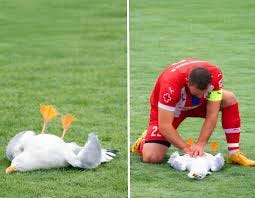
(The video is worth watching. The camera followed the bird, not the ball.)
The goalkeeper, Muhammet Uyanik, said he didn’t realize at first what he’d hit. “I felt very bad afterward,” he said. “It affected me deeply. After all, it’s a living being.” Team captain Gani Catan reached the bird first. It was unresponsive. Catan had no formal first aid training. He did what seemed obvious to him: he knelt down and began chest compressions on the seagull’s ribcage. For two minutes he worked, carefully, while players from both teams clustered around him — one man apparently took the opportunity to tie his shoe, which is the correct priority — until the bird’s legs began to move. Its eyes opened. Players gave it water. Catan cradled it and carried it to medical staff on the sideline.
Ornithologists might note that birds knock themselves out flying into things all the time, and often come around on their own after a few minutes. But Gani Catan did not know that. He saw a bird fall fall and he tried. The seagull sustained a damaged wing. It was walking within days. Istanbul Yurdum Spor lost the match, was eliminated from the playoffs, and did not win the championship.
Catan was asked afterward how he’d made the decision so quickly. “The first thing that came to my mind,” he said, “was heart massage, because it couldn’t breathe. So I tried my luck.”
Afterward, this Facebook post got some amazing comments, such as”
"He gave it Sea-PR? I'll see myself out..."
"That seagull owes him a life debt. In his darkest hour, it will be repaid..."
"The only seagull tough enough to take it would've been Steven Seagull"
"I didn’t know CPR worked on birds…"
"I wonder why Dani Rojas didn’t try this with the hound? I mean, everyone just froze"
"Did the ref blow for a fowl?"
"I like how he’s described as having no training, but he’s got a Red Cross on his sleeve…"
"I'm wanting to see this with a sqeaker toy sound edited over the compressions"
"I'm marrying this guy!"
MY TAKE: He tried his luck. On a seagull. With chest compressions. In a playoff final he then lost. Gani Catan is a captain in every sense of the word — not because he’s good at football, though he may be, but because when something fell in front of him, his first instinct was to try. And then the world saw it, and found the fun in it along with the human interest. I remember a round of golf when a member of our foursome hit the ball into a tree and a mockingbird fell out. In Texas harming the state bird can get you in trouble. In Istanbul, I think you’d have to be careful around a turkey.
Happy as Larry
On October 9th, Debra Brown and her family were doing what they always do when they take their quad bikes to Wharton Beach, on the remote south coast of Western Australia: clearing trash. They’ve hauled away truckload after truckload over the years — wine bottles, debris, whatever the ocean leaves. Among the bottles that day was a thick Schweppes glass bottle, sealed with a cork, resting just above the waterline. Debra brought it home, set it on a windowsill to dry, and used tweezers to extract two letters written in pencil, dated August 15, 1916.
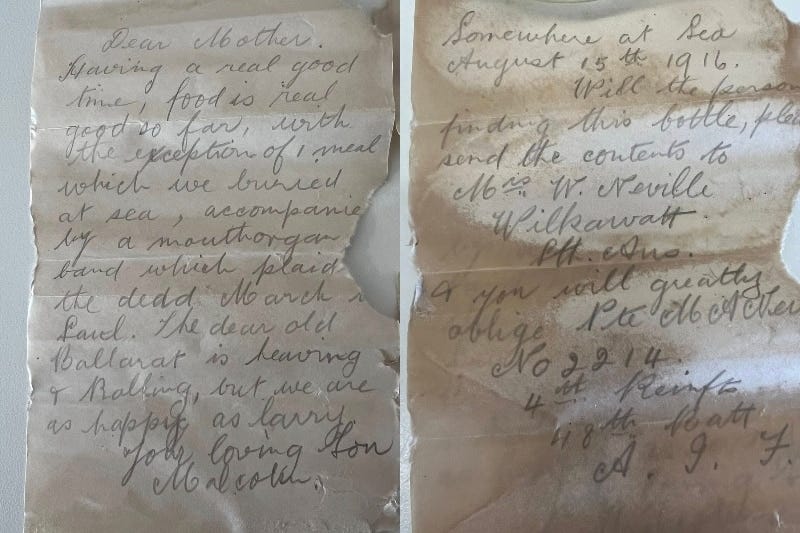
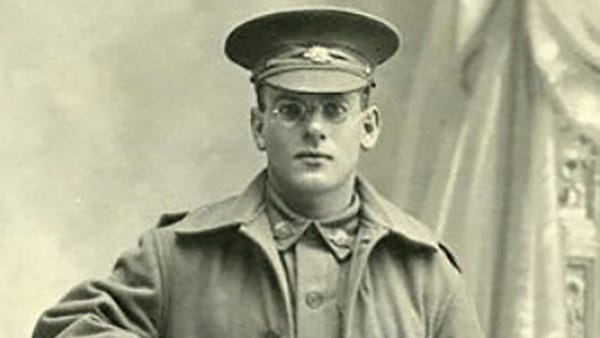
Private Malcolm Neville, 27, and Private William Harley, 37, had written them aboard a troopship leaving Adelaide — bound for the battlefields of France. Neville wrote from “Somewhere at Sea.” The food was good, he reported, with one exception they had buried at sea. The ship was heaving and rolling. He and his mates were, he said, “happy as Larry” — an old Australian expression for very happy. He asked whoever found the letter to please forward it to his mother in Wilkawatt, South Australia.
Harley had no mother to write to. He addressed his letter simply to the finder of the bottle.
Debra Brown went to work. She found Neville’s great-nephew Herbie on Facebook, matching the soldier’s name to his hometown. She found Harley’s granddaughter Ann Turner through the Australian War Memorial’s website. She learned that Neville had tried to enlist in 1916 and been turned away within a week — his eyesight was too poor for the army’s standards. He came back through a different door, joining the Service Corps. He was killed in France in April 1917, eight months after writing the letter. Harley came home, married his childhood sweetheart, and died in 1934. The bottle, Debra believes, never traveled far — buried in the sand dunes near where it was thrown, until 109 years of coastal erosion finally let it go on a Tuesday she happened to be picking up trash.
Herbie Neville said that since the letter arrived, cousins who had drifted apart were back in contact. Ann Turner said her family was “absolutely stunned.” She reflected on the difference between the two letters — Neville writing home to his mother, Harley writing simply to whoever might find it. “I feel very emotional,” she said, “when I see that the other young man had a mother to write to.”
The bottle is in pristine condition. Not a single barnacle.
MY TAKE: Malcolm Neville was turned away by the army and came back through a different door. That tells you something about him — the kind of man who, when a ship is rolling toward a war he won’t come home from, still thinks to write a letter and throw it into the sea. He was covering his bases. He was trying to reach people. He’d been doing that his whole short life. And William Harley, who had no mother left to address it to, wrote to the finder anyway — to whoever was out there, whoever might someday hold the bottle. One hundred and nine years later, a woman who makes it her business to pick up after the world found it in the sand and decided that delivering the mail — even mail this old, even mail from men a century gone — was simply what you did next. The cousins called. The families found each other. “Happy as Larry,” he wrote, from somewhere at sea, at 27, going to war, meaning every word of it.
SUMMING IT UP
This week a squirrel built a nest inside the wrong infrastructure, a backup system failed because nobody checked, and a county administrator delivered the findings with the resignation of a man who has stopped being surprised by anything. Teenagers in Argentina ran on all fours in a public park and felt like they weren’t alone. Washington State apologized for its robot. A man with no training pressed on a seagull’s chest until its eyes opened. Fifty-six batteries died so that Minesweeper could be played. And Debra Brown, who makes it her business to pick up after the world, found a sealed bottle in the sand and decided that delivering a dead man’s letter to his family was the right thing to do.
No thread connects these stories except the one that always runs through an NYN roundup, if you look: people, with names, doing people-y things. Gani Catan tried his luck on a seagull. People on FB commented, and that was funny. Malcolm Neville wrote to his mother from a rolling ship. The cousins called. The families reconnected.
The news outside this window is loud. But it was also a week when we saw people going about their lives in their own ways. You might not be happy as Larry, but you might find a better balance. And baby …
… that’s the news you need.
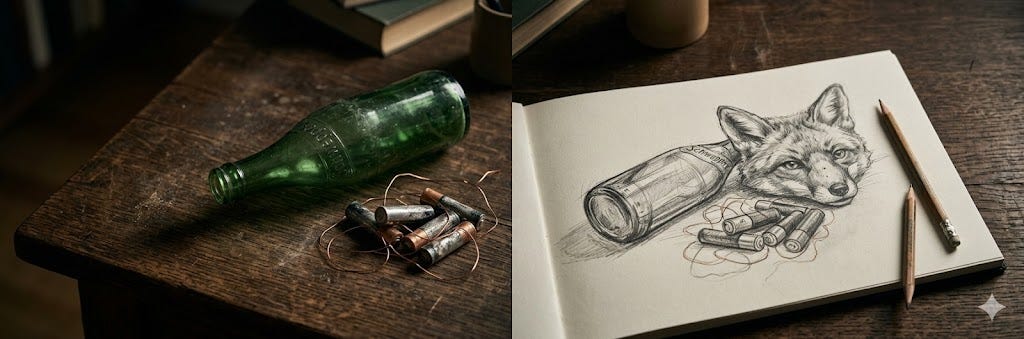
Visuals directed by J. "Jimmy" Artus for The News You Need.
Excellent, and very needed
Imagine my surprise the day after I published this, when two of the stories were mentioned on “Wait Wait Don’t Tell Me.” I really enjoy that show in the car.